
Decoralot is reader-supported. When you buy through links on our site, we may earn a commission at no cost to you — and it never influences our picks. See how we choose.
Quiet luxury is the room that never raises its voice. No statement wallpaper shouting for attention, no brass everything, no piece chosen because a feed approved of it... just deep comfort, beautiful materials, and the unmistakable sense that every object earned its place. It is the hardest look to fake and, once you understand its logic, one of the most achievable to build.
The logic is this: quality concentrated in few things beats novelty spread across many. Below are twelve ways that principle becomes a living room — each one buildable, each with the pieces to start from. Also, make sure to read our article on the history of quiet luxury.
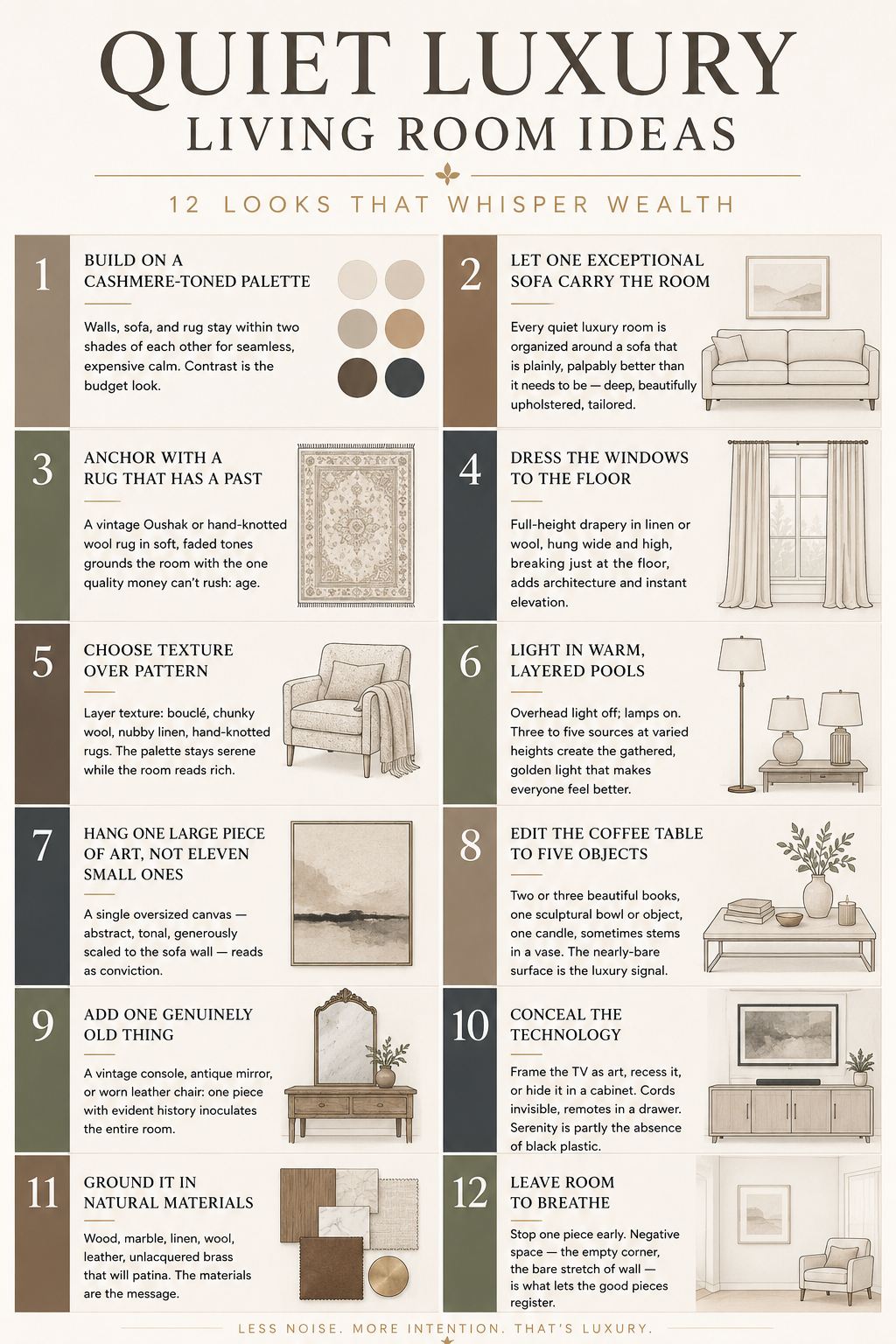
1. Build on a Cashmere-Toned Palette
The quiet luxury palette is borrowed from a beautiful wardrobe: oatmeal, camel, ivory, greige, chocolate, with charcoal for depth. Walls, sofa, and rug stay within two shades of each other, which is what produces that seamless, expensive calm. We map the exact shades in the colors that make a room look expensive.
2. Let One Exceptional Sofa Carry the Room
Every quiet luxury room is organized around a sofa that is plainly, palpably better than it needs to be: deep, beautifully upholstered, tailored. It is the single highest-leverage purchase in the look.
[LASSO DISPLAY: best luxury sofas — top 3 quiet luxury picks]
3. Anchor With a Rug That Has a Past
A vintage Oushak or hand-knotted wool rug in soft, faded tones grounds the room with the one quality money can't rush: age. It also quietly signals that this room was collected, not ordered. Our high-end rug guide covers both the vintage hunt and the new pieces with old souls.

Sponsored
Dorval Washable Vintage Woodland Charcoal Gray Rug - 5' x 7'
Bring the quiet poetry of a woodland path into your home with the Dorval Rug Collection. Inspired by vintage tapestries and forest folklore, each rug features graceful deer, symmetrical florals, and antique-inspired scrolls that echo nature’s harmony. Crafted from ultra-soft…
Shop Lahome →4. Dress the Windows to the Floor
Few upgrades transform a room faster than full-height drapery in linen or wool, hung wide and high, breaking just at the floor. Skimpy curtains are the most common tell in otherwise expensive rooms; generous ones add architecture even to a builder-grade box.
5. Choose Texture Over Pattern
Where a louder room uses print, quiet luxury layers texture: bouclé on an accent chair, a chunky wool throw, nubby linen pillows, a hand-knotted rug underfoot. The palette stays serene while the room reads rich at every touchpoint.

Sponsored
Bubble Armchair
Overview The Bubble Sofa offers visual delight and exceptional comfort. Its generously padded seat and backrest provide luxurious support, inviting relaxation. Its curved form creates a cocoon-like embrace, evoking tranquility. Whether a statement piece in living rooms or a cozy…
Shop Interior Moderna →[LASSO DISPLAY: best bouclé accent chairs]
6. Light in Warm, Layered Pools
Overhead light off; lamps on. Place three to five sources at varied heights. A floor lamp by the reading chair, table lamps on consoles, and warm bulbs throughout produce the gathered, golden evening light that makes everyone in the room look and feel better.
7. Hang One Large Piece of Art, Not Eleven Small Ones
A single oversized canvas such as an abstract, tonal, generously scaled to the sofa wall reads as conviction. Gallery walls with little pieces of varied artwork do have their place, but the specific look we're talking about in this article isn't it. Original works from our wall art guide do this for less than you'd think.

Sponsored
Abstract Stormscape
Overview Introducing our latest masterpiece: "Abstract Stormscape: Vivid Color Palette Canvas". This stunning large-scale painting captures the essence of a tumultuous storm with its dynamic composition and vibrant color palette. Splashes of bold colors mingle with hints of black, creating…
Shop Interior Moderna →8. Edit the Coffee Table to Five Objects
Two or three beautiful books, one sculptural bowl or object, one candle, sometimes stems in a vase. The discipline of the nearly-bare surface is itself the luxury signal. Clutter is visual noise; quiet luxury is, well... quiet.
9. Add One Genuinely Old Thing
A vintage console, an antique mirror with foxed glass, a worn leather chair: one piece with evident history inoculates the entire room against the showroom look. One is enough. This is seasoning, not theme.
10. Conceal the Technology
The television in a quiet luxury room is a design problem to be solved. Frame it as art, recess it, put it in a cabinet, or simply don't grant it the room's focal point. Organize the cords and put remotes in a drawer. Serenity is partly the absence of black plastic.
11. Ground It in Natural Materials
Wood with visible grain, marble or travertine with honest veining, linen, wool, leather, unlacquered brass that will patina. Quiet luxury distrusts anything pretending to be something else. The materials are the message.

Sponsored
Milan Modern Round Marble Side Table with Curved Block Legs / Galaxy Blue
Made for gathering around for cozy chats and stylish soirées. With its luxurious marble top and curved block legs, the Milan Modern Round Marble Side Table with Curved Block Legs effortlessly plays the role of a chic centerpiece.
Shop Eternity Modern →12. Leave Room to Breathe
The final move is the hardest: stop one piece early. Negative space — the empty corner, the bare stretch of wall — is what lets the good pieces register. Crowded rooms read anxious; this room knows exactly what it has.
Bringing It Home
Start with the palette (#1), invest in the sofa and rug (#2–3), and let the remaining ideas accumulate over seasons rather than weekends — the collected-over-time quality is the point, not a shortcut. For the buying decisions, begin with our luxury sofa guide and high-end rug guide; for the philosophy in full, the Quiet Luxury style hub awaits.
Frequently Asked Questions
What colors define a quiet luxury living room?
Warm, low-contrast neutrals — oatmeal, camel, ivory, greige, soft chocolate — with charcoal or deep green as the darkest note. The signature is tonal harmony: everything within a narrow, warm range.
Can I achieve quiet luxury on a budget?
Substantially, yes — the look depends more on restraint than receipts. Full-height curtains, edited surfaces, warm lamp light, and one quality vintage piece transform a room for hundreds, not thousands; then upgrade the sofa and rug as budget allows.
What's the difference between quiet luxury and minimalism?
Temperature and texture. Minimalism subtracts toward emptiness and often runs cool; quiet luxury subtracts toward richness — fewer things, but each deep in material quality and comfort. A minimalist room can feel austere; a quiet luxury room never does.