
Decoralot is reader-supported. When you buy through links on our site, we may earn a commission at no cost to you — and it never influences our picks. See how we choose.
North-facing rooms are the ones interior designers quietly dread — and secretly love once they're solved. Because they never get direct sun, north light is cool, flat, and bluish, and it's brutally unforgiving: it drains warmth out of color, exposes every undertone, and turns the wrong white into a dreary grey-blue by mid-afternoon. But the same room, painted right, becomes the most beautifully serene space in the house. The trick is understanding what north light does and choosing color to counteract it.
Here's the designer logic, the shades that work, and the ones to avoid — so your north-facing room glows instead of sulks.
Why North-Facing Rooms Are Tricky
A north-facing room receives only indirect, ambient daylight, which has a cool, blue-leaning quality and stays fairly constant (and dim) through the day. That cool light does three things to paint: it amplifies cool undertones (a grey with blue in it will read distinctly blue), it mutes and greys-down color generally, and it makes stark whites look dingy and lifeless. The entire strategy, then, is to add warmth back — choosing colors with warm undertones that the cool light will balance rather than exaggerate.

Bloom & Wall - Sponsored
Bold Yellow Floral Wall Mural | Large Botanical Art Nouveau Wall Decor | Vintage Style Flower Wallpaper
Bold Yellow Floral Wall Mural | Large Botanical Art Nouveau Wall Decor | Vintage Style Flower Wallpaper | Peel & Stick or Paste Transform your space with this stunning large-scale floral wall mural, featuring a vivid yellow hibiscus and botanical…
Shop Bloom & Wall →The Rules for North-Facing Rooms
Embrace warm undertones. This is the master rule. Whatever color you choose, favor the version with a warm (yellow, red, or earthy) undertone over the cool (blue, green-grey) one. The north light will cool it down to just-right; a cool undertone will be pushed into chilly territory.
Don't fight the cool — or lean all the way in. You have two valid strategies. Counteract with warm, sunny, enveloping colors that inject the warmth the room lacks. Or embrace the cool with a moody, dramatic dark color that turns the dim light into an intentional, cocooning atmosphere. What rarely works is the timid middle: a pale cool grey that just reads cold and sad.
Choose complex, layered colors. North light flattens, so flat single-pigment colors look especially lifeless in it. Complex colors mixed from many pigments hold their richness and shift beautifully even in cool light.
Test on every wall, at every hour. More than any other room, a north-facing space demands large painted samples observed morning, noon, and night, on multiple walls — color behaves very differently here than on the chip or in a south-facing showroom.
The Best Colors for North-Facing Rooms
Use the chart below as a quick-reference guide when choosing the best colors for north-facing rooms, or rooms without direct sunlight - and learn the colors to avoid.
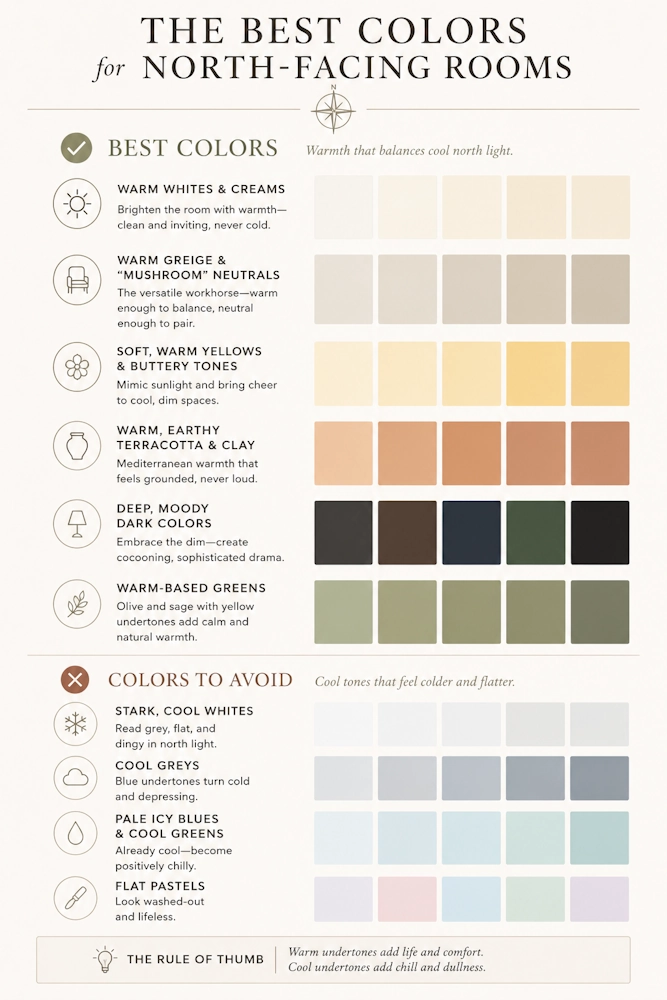
Warm whites and creams (never stark white)
If you want the room light, the answer is a warm white or cream with a yellow or red undertone — it reads clean and bright where a stark blue-white would read grey and cold. This is the single safest fix for a dim north room you want to keep airy.
Warm greige and "mushroom" neutrals
A greige with a warm (rather than cool) base is the versatile workhorse for north rooms — enough warmth to counter the blue light, enough neutrality to flatter furnishings. Mushroom and warm taupe tones do the same job with a touch more depth.
Soft, warm yellows and buttery tones
The classic designer prescription for a dark, cool room is a soft warm yellow — not bright or acidic, but buttery and muted. It mimics the sunlight the room never gets and turns a gloomy space genuinely cheerful. One of the few rooms where yellow truly earns its place.
Warm, earthy terracotta and clay
Muted terracotta and clay tones bring Mediterranean warmth that north light tempers beautifully — the cool balances the earthiness so it never reads loud. Lovely in dining rooms and studies that want to feel enveloping.
Deep, moody dark colors (the embrace strategy)
If the room is dim regardless, lean in: a deep charcoal, warm chocolate, inky navy, or forest green turns the cool, low light into a deliberate, cocooning drama. North-facing studies, dining rooms, and bedrooms are ideal candidates for this confident, expensive-looking move.
Warm-based greens
An olive or warm sage — green with a yellow rather than blue base — behaves like a sophisticated neutral in north light and brings a natural, grounding calm without the chill a cool blue-green would take on.
Colors to Avoid in North-Facing Rooms
Stark, cool whites — they read grey, flat, and dingy in cool light. Cool greys with blue undertones — north light pushes them straight to cold and depressing. Pale icy blues and cool greens — already cool, they become positively chilly. Flat pastels — they tend to look washed-out and lifeless. The theme is consistent: anything cool-undertoned gets colder, anything flat gets flatter.

Bloom & Wall - Sponsored
Enchanted Forest Wall Mural – Mystical Tree Tunnel Nature Wallpaper
Enchanted Forest Wall Mural for Bedroom – Mystical Tree Tunnel Nature Wallpaper Transform your bedroom into a magical woodland retreat with this enchanted forest wall mural. Featuring a stunning tunnel of ancient trees and glowing greenery, this high-resolution nature wallpaper…
Shop Bloom & Wall →How This Differs From South-Facing Rooms
It's worth knowing the contrast, because advice for one is often wrong for the other. South-facing rooms get warm, abundant light all day and can handle — even benefit from — cool colors that would die in a north room; cool greys, blues, and crisp whites look fresh and balanced there. East-facing rooms get warm morning light and cooler afternoons; west-facing the reverse. North-facing rooms are the only ones that get no direct sun at all, which is exactly why they need the most warmth added back. (For the colors that read expensive in any light, see our guide to colors that make a room look expensive.)
Putting It Together
For a north-facing room you want bright and airy: choose a warm white or warm greige, add warmth through wood tones and textiles, and layer in plenty of warm lamp light. For one you're happy to make moody and intimate: embrace a deep, warm-undertoned dark, and let warm metals and lighting make it glow. Either way, warmth — in the paint, the materials, and the light — is the answer to cool north light. Tie the room together with the right furnishings via our Living Room and Bedroom hubs.
Frequently Asked Questions
What is the best paint color for a north-facing room?
A warm white or warm greige is the safest choice for keeping the room light, while a soft buttery yellow or a deep, warm-undertoned dark (charcoal, navy, chocolate, forest) are the best ways to add cheer or drama. The unifying rule: choose warm undertones to counteract north light's cool, blue cast.
Why do north-facing rooms look blue or cold?
Because they receive only indirect, ambient daylight, which is naturally cool and blue-leaning. That light amplifies any cool undertone in your paint and mutes warmth, so cool colors look colder and stark whites look grey and dingy.
Should I paint a north-facing room white?
Only a warm white or cream, never a stark or blue-based white. A warm white reads clean and bright in cool light, while a cool white turns grey and lifeless. If the room is quite dim, consider embracing it with a moody dark color instead of forcing brightness.
What colors should I avoid in a north-facing room?
Avoid stark cool whites, blue-based greys, icy blues, cool greens, and flat pastels — north light makes all of them read cold, flat, or dingy. Favor warm-undertoned versions of any color you love instead.
Related Guides
Colors That Make a Room Look Expensive · Quiet Luxury Living Room Ideas · Living Room Hub · Bedroom Hub · Color & Palettes Hub