
Decoralot is reader-supported. When you buy through links on our site, we may earn a commission at no cost to you — and it never influences our picks. See how we choose.
A beautifully set table is one of the most accessible luxuries there is. It costs almost nothing beyond what you already own, yet it transforms an ordinary meal into an occasion and signals care to everyone seated. The good news: there's a simple logic to it. Learn the basic place setting and a few layering tricks, and you can set a table that looks considered for a Tuesday dinner or a holiday feast alike. Here's the designer's guide.
The Basic Place Setting (Everyday)
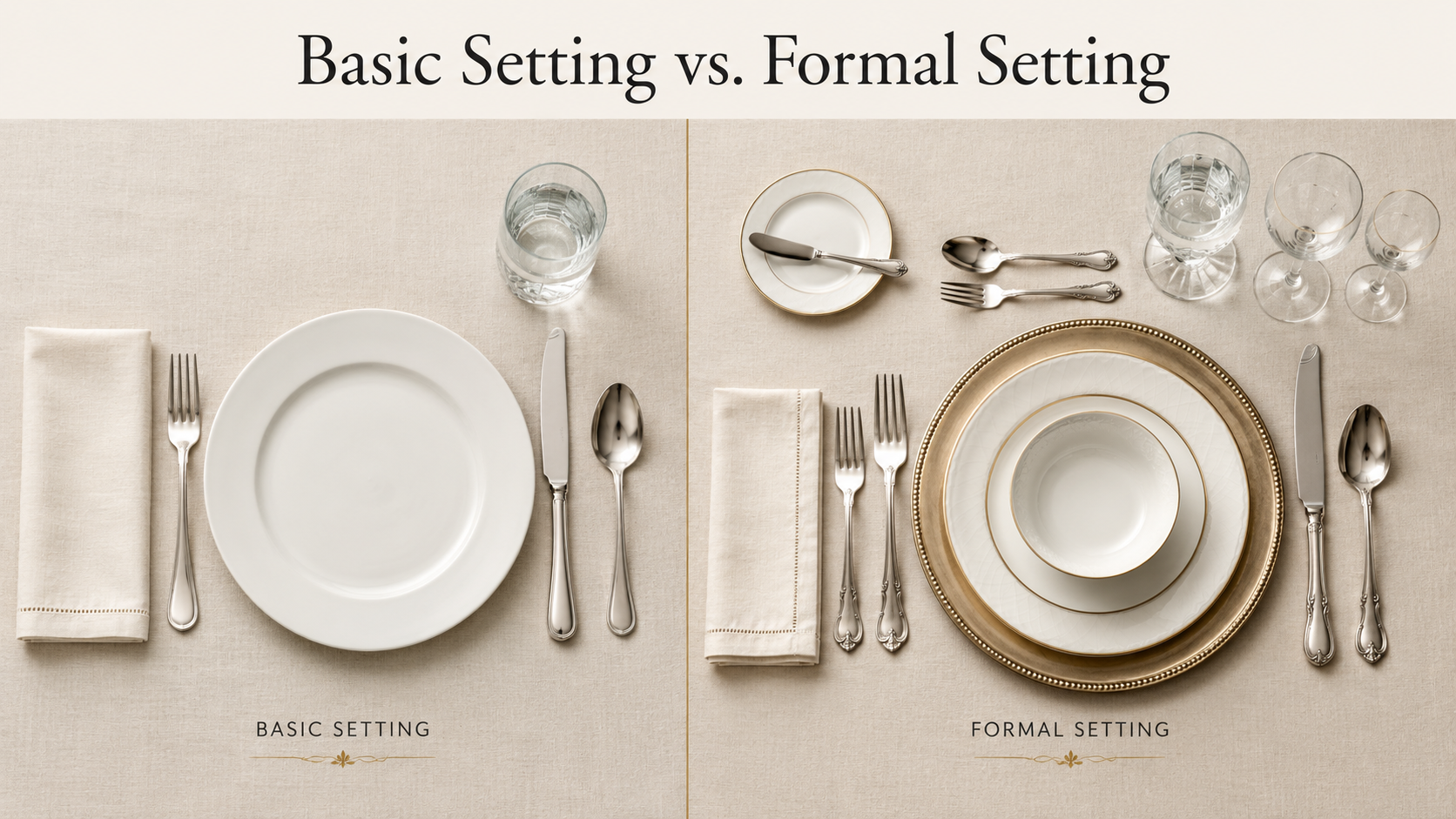
Start here — this is the foundation everything else builds on. For a casual everyday setting, you need surprisingly little:
- Dinner plate centered, about an inch from the table edge.
- Fork on the left of the plate.
- Knife on the right, blade facing in, with the spoon to its right.
- Napkin to the left of the fork (or on the plate).
- Water glass just above the knife.
That's a complete, correct everyday setting. Everything more formal is simply this, layered up. Quality everyday dinnerware is what makes even this simple arrangement look elevated.
The Formal Place Setting
For a dinner party or holiday, add layers in a logical order. The guiding rule that solves most confusion: utensils are used from the outside in, so set them in the order courses will be served.
- Charger (a decorative under-plate) anchors the setting; the dinner plate sits on it, with a salad or soup bowl on top.
- Forks on the left, outside-in: salad fork outside, dinner fork inside.
- Knives and spoons on the right, outside-in: soup spoon outermost, then knife (blade in).
- Bread plate with a small butter knife at the upper left.
- Glasses upper right: water glass largest, with wine glass(es) to its right.
- Dessert utensils placed horizontally above the plate, or brought with dessert.
- Napkin on the plate or to the left.
It looks elaborate, but it's just the everyday setting with more courses accounted for, as you can see illustrated by our Basic Setting vs. Formal Setting chart below. Beautiful dinnerware, glassware, and flatware make a formal setting sing.
Layering & Texture: The Designer Difference
What separates a merely correct table from a beautiful one is layering — the same principle that elevates a room. Build the table in layers: a tablecloth or runner as the base, placemats for definition, a charger under the plate, the dinnerware, and a folded or ringed napkin on top. Each layer adds depth and a sense of occasion. Mixing textures — a linen runner, ceramic plates, woven placemats, hammered flatware — reads richer than a flat, matched set.
The Centerpiece & Height Rule
A centerpiece anchors the table, but the cardinal rule is keep it low or high, never in between: either a low arrangement (under about 12 inches) that guests can see over, or tall, slim stems/candlesticks that sightlines pass beneath. A bushy mid-height centerpiece blocks conversation. Fresh flowers, a low bowl of seasonal fruit, greenery down a runner, or grouped candles all work — and candlelight is the single most flattering, occasion-making addition to any table.
The Finishing Details
The small touches signal real care: cloth napkins (always more elevated than paper), a napkin ring or a simple fold, place cards for a seated dinner, candles for warmth, and a considered color story that ties the table to the season or the room. None is expensive; together they turn a meal into hospitality. For the full hosting picture, see our entertaining guides.
Everyday vs. Formal: A Quick Reference
| Element | Everyday | Formal |
|---|---|---|
| Plates | Dinner plate | Charger + dinner + salad/soup |
| Forks | One (dinner) | Salad + dinner (outside-in) |
| Knives/spoons | Knife + spoon | Soup spoon + knife (outside-in) |
| Glasses | Water | Water + wine glass(es) |
| Napkin | Left of fork or on plate | On plate or left, often ringed |
| Extras | — | Bread plate, place cards, charger |
Frequently Asked Questions
Which side do the fork and knife go on?
The fork goes on the left of the plate; the knife on the right with the blade facing in toward the plate, and the spoon to the right of the knife. An easy memory trick: "fork" and "left" are the shorter words, "knife," "spoon," and "right" the longer ones. For formal settings, add utensils outside-in in the order courses are served.
What is the correct order of utensils for a formal setting?
Utensils are used from the outside in, so set them in course order: the salad fork outside the dinner fork on the left; the soup spoon outermost, then the knife on the right. Dessert utensils go horizontally above the plate or arrive with dessert. Guests simply work inward with each course.
How do I make an everyday table look elevated?
Layer it: add a runner or placemats, use cloth napkins instead of paper, include a simple low centerpiece or a few candles, and use quality dinnerware. These small, mostly free touches turn a plain weeknight table into something that feels considered and special.
How tall should a table centerpiece be?
Keep it either low (under about 12 inches, so guests see over it) or tall and slim (stems or candlesticks that sightlines pass beneath). Avoid bushy mid-height arrangements that block conversation across the table. Candlelight is the most flattering, occasion-making addition.
Related Guides
Best Luxury Dinnerware · Entertaining & Hosting Hub · Dining Room Hub · Best Dining Tables · Best Chandeliers