
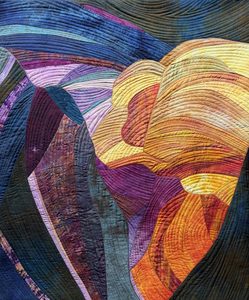
23” x 27.5”
Photo courtesy of Barbara Behrmann.
What started out as a way to procrastinate in writing her dissertation, Barbara Behrmann’s search for a creative outlet led to a journey in creating art from fabric. In this interview, Behrmann speaks to us about her transformation from seeing fabric as purely functional, to seeing it as an art medium. Her journey comes on the heels of a broader shift in the art world, as textiles have increasingly gained wider cultural acceptance as celebrated forms of contemporary art.
Throughout that journey, what has always been present is Behrmann’s intense love of color. Not just color...but pure, intense color that she harmonizes beautifully in her work.
Along the way, Behrmann learned to create her own hand-dyed fabric, examples of which you can see in the set of her hand-dyed samples below. This was key to not only allowing her to wield color in the abstract, painterly fashion that was calling to her, but also to changing the way she thought about fabric.
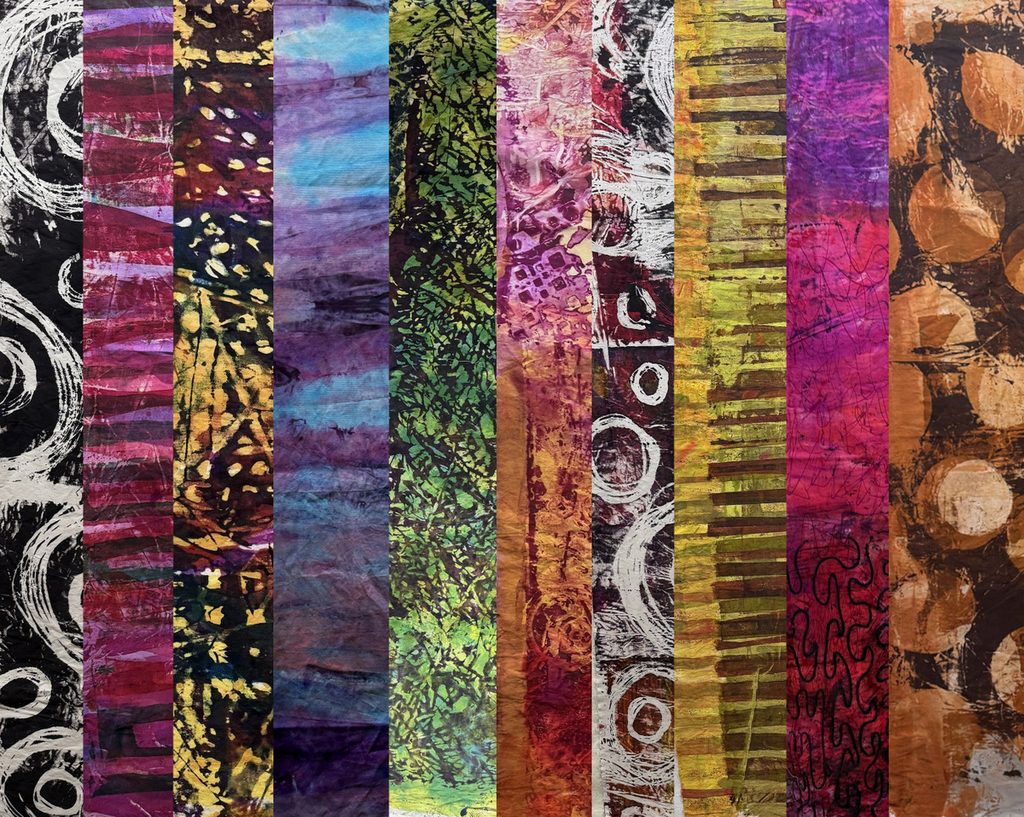
In this interview, Barbara also talks with us in great detail about her techniques, the role of experimentation in her work, and her discovery of the link between improvisation and originality.
Keep reading to find out more.
Q: You mentioned that you started with traditional quilting in the late 1990's after seeing a friend's quilt at a local show, and an hour later you'd signed up for an intro class and bought $60 of fabric. What was it exactly about that quilt, or experience of the show, that pulled you in to quilting?
A: "I think I was looking for some kind of creative outlet that I could pursue at home, one that could fit into the life of a young mother. I had dabbled in pottery, partly as a way to procrastinate working on my dissertation, but when I became pregnant, I knew I had to focus on completing it. Eventually, I couldn’t even lean over the wheel and, after my daughter was born it was impossible to commit to being in the pottery studio at precise times. I briefly tried watercolors, but that didn’t go anywhere.
A friend of mine designed upholstery fabric and was also a traditional quilter. She had made a gorgeous bed quilt for her three year-old son and entered it in a local quilt show. I remember being impressed by her talent, but not thinking that quilting was something I would do. It wasn’t part of my family tradition and I had no desire to sew.
“You never know when a seemingly insignificant moment turns out to be transformative.”
But you never know when a seemingly insignificant moment turns out to be transformative. Because when I stopped by the quilt show, almost 30 years ago, I was blown away! I had always loved color, and suddenly, color was all around me. I don’t recall exactly what I imagined a quilt show would look like, but this wasn’t it! The colors, patterns, designs, and variety in the work captivated me. I impulsively signed up for an introductory class and purchased my first few fabrics.
Here was a creative outlet that I could pursue at home, working around the demands of parenting my daughter. In fact, the first two quilts I ever made were a bed quilt for my then three year-old and, because I was pregnant again, a baby quilt. Moreover, it would enable me to recapture the delight of opening a new box of pristine crayons on the first day of school."
Q: It seems you began working within traditional block structures before you found yourself drawn to improvisation instead. What did that shift feel like, and what made improvisational piecing so much more liberating for you?
A: "I would characterize the transition as a move away from functional quilts based on traditional blocks and toward quilts as art, rather than function. Improvisational techniques were only part of that transition. In fact, my first steps in that direction still involved working with traditional blocks, but using them in non-traditional designs, experimenting with composition, color and value.
I quickly learned, however, that matching points and following patterns requiring exact measurements became exercises in frustration. I have many good qualities, but patience and precision are not among them! The more quilts I saw and the more quilting books I read, the more I discovered that what made my heart race were the ones that looked like abstract paintings. And many of them didn’t require matching points. In fact, some of them were created by fusing fabrics together, even glueing them, rather than by sewing them with thread. All of them offered more freedom and possibility and to me, more fun and excitement.
At the same time, I became increasingly convinced that I wanted to create original work based on my own designs, rather than following someone else’s pattern. Improvisational techniques gave me the freedom to play without knowing exactly where I was going. And when you’re working improvisationally, it’s almost by definition impossible to replicate someone else’s work. That sense of freedom and individuality turned out to be what I was looking for."
Q: You've described your path as self-taught and "not linear." Looking back at that first quilting class, what's the one thing that changed the most since then in how you think about fabric as an art medium?
A: "First, I should qualify self-taught. It doesn’t mean I haven’t taken classes and workshops. I simply don’t have a formal or academic background in art.
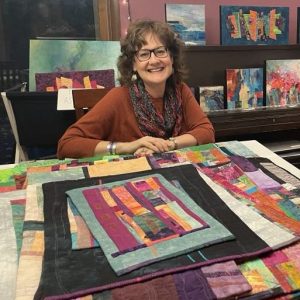
Photo courtesy of Barbara Behrmann
I think the biggest change is that I no longer see fabric simply as a material to sew, but as a creative source and artistic medium. I have a deeper understanding of its artistic power with endless possibility.
I mentioned earlier that the quilts that spoke to me the most were those that looked like abstract paintings. I also realized that I was continually drawn to quilts made with hand dyed fabrics. Eventually, after spending a small fortune buying other people’s hand dyes, I decided it was time to conquer my intimidation of working with chemicals and learn to make my own. That was about eight years ago and it changed how I think about fabric.
Today I see a piece of white cotton as a canvas, a surface on which I can print, paint or dye. Unlike a painting, though, it is a canvas that, more often than not, is intended to be cut up.
I think of my collection of fabrics much like a collection of paints. They give me a library of color, texture, and visual possibility to draw from. I cut them, arrange and rearrange them on a design wall, and gradually constructing colorful and dynamic compositions.
At the same time that I was becoming more interested in creating original fabrics, I came to learn more about a cultural shift that was taking place around quilting and the fiber arts. Museums, galleries, professional organizations, publications, and increasingly competitive juried exhibitions, were helping to establish textiles as legitimate forms of contemporary art.
While some fiber artists have roots in traditional quilting - one of the few creative outlets historically accessible to women - many have backgrounds in the fine arts. Many, like me, design their own fabrics using dyes, paints, and other mediums, much as painters, printmakers and other artists develop their own approaches to their materials. And, like all artists, fiber artists work with the same fundamental elements and principles of design –the medium is simply different."
“When you’re working improvisationally, it’s almost by definition impossible to replicate someone else’s work.”
Q: You mention that a lot of your work starts with fabric you've hand-dyed yourself using fiber-reactive dyes. Please walk us through what that process looks like. How much of the final piece do you already have in mind before you start dyeing, versus how much comes from what the fabric does on its own?
A: "Two separate questions – I’ll start with the latter. Some artists approach fabric dyeing with carefully measured recipes and exact proportions of dye powders. I so admire that kind of precision, but I’m much more loosey-goosey about it. For me, that’s part of the fun. There is always an element of surprise. Even when I try to replicate a fabric I’ve made before, it’s virtually impossible to create exactly the same thing twice.
So many variables can influence the final result. How much dye did I use? What proportions of different colors did I mix, and did they fully blend or separate to reveal their individual components? How long did the dye react with the fabric before I washed it out? If I’m doing an immersion technique, how did I arrange the fabric in the dye? Did I roll, twist, fold, or scrunch it—and how tightly? While an understanding of color theory definitely helps, there’s something wonderfully unpredictable about seeing what happens when different dyes overlap and interact.
Finally, certain techniques are unpredictable by their nature. For example, one technique involves putting dampened fabric in a colander, covering it with ice or snow, and then sprinkling dye powders over the top. As the ice or snow melts, the dyes travel through the fabric creating patterns and color combinations in wildly unpredictable ways. Another technique I use involves spreading thickened dye on a silk-screen and placing random objects into the wet dye. After the screen has dried, I carefully remove the objects, leaving their imprint in the dye. I then place the silk screen over the fabric and apply a thickened wetting agent. As I pull it across the screen, it reactivates the dried dye, releasing it at different rates and creating unexpected results.
In short, I can control some of the variables, but never all of them, and I wouldn’t want to. Some of the most interesting fabrics emerge when the dyes do something I hadn’t anticipated.
You also asked about the dyeing process. This is another complicated question, because there isn’t one process, but many. I like to have a wide range of colors, values, and textures to draw from, so I use over a dozen different surface design techniques. I tend to divide them into two broad categories: those that involve immersing the fabrics in liquid dyes and those that use thickened dyes for printing and painting.
Both begin with mixing the dye powders - I use Procion MX fiber reactive dyes - and preparing the fabric so that it can accept the dye. This involves soaking the fabric in a solution of water and soda ash, which raises its pH and makes it more alkaline. Depending on the technique, the fabric may be treated with soda ash before or after it is dyed.
A lot of the printing technique I use start with making a thickening agent from sodium alginate, a powder derived from seaweed. Thickening the dye gives me greater control and lets me use the dye with stencils, stamps, sponges, and various other resist techniques, many of which also involve using a silk screen.
Depending on the colors and techniques I use, it can take up to 24 hours for the dye to fully react with the fabric. Then I rinse, wash, dry, and iron them. At that point, I’m ready to add them to my stash of fabrics, the collection of raw materials from which I create my quilts.
“I like to build a diverse selection of colors, patterns, and textures that I can “audition” when I’m creating a new project.”
In general, I don’t make fabrics with a particular project in mind. Instead, I like to build a diverse selection of colors, patterns, and textures that I can “audition” when I’m creating a new project. Occasionally, there is a piece of fabric that I just can’t bring myself to cut up and I’ll use it as the basis for a whole-cloth quilt. But more often than not, the fabrics become the contemporary equivalent of the box of crayons that excited me when I was six years old. They are there, ready to be used and combined in all sorts of ways!
Of course, dyeing the fabric is only the beginning. After I’ve finished creating the quilt top, I layer it with batting and another fabric on the back. These three layers are then held together with decorative lines of stitching that contribute texture and movement, after which I finish the edges and add a sleeve to the back so that it can be displayed.
There are variations in all of these steps, of course, and other art quilters may work differently, but that’s the general process. In short, there are a lot of stages and steps between a piece of white cotton and a finished art quilt and each one offers opportunities for making creative decisions."
Q: Your series, like 'Wanderlust,' and your Finger Lakes pieces, often start from a specific place or photograph, but you've stated that the finished quilt rarely resembles where it started. What is it that usually pulls a piece away from its original reference point?
A: "It depends on how I use the photograph. If I use it as the foundation for a sketch on muslin, the finished piece is usually more predictable. But if I’m working improvisationally, using the photograph as more general inspiration, I’m much more likely to end up some place quite different.
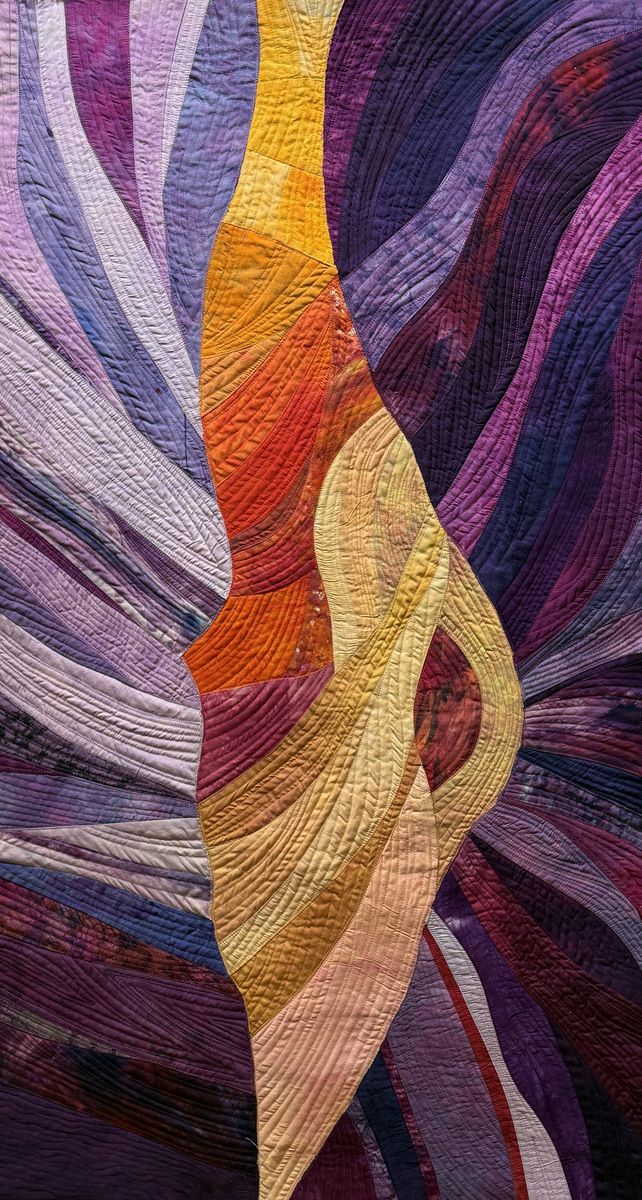
For example, I have a quilt called Abandoned Rock Wall, so named because it was based on a photograph I took of an old rock wall I came upon while hiking in Colorado. I quilted each layer, each “rock,” improvisationally, composing as I went, letting color and value drive the design. When I thought I had finished, I noticed that my eye went immediately to two, thin, dark fabrics placed horizontally near the center, a huge design faux pas. I ended up removing the bottom third of the quilt and creating a different, shorter, bottom section. That solved the problem, but now I had a leftover section of the original design, approximately 31 x 14 inches. I wondered what it would look like vertically and voila! It worked so much better. I call it “Landslide,” since the orientation no longer suggests the stability of a wall.
That happens quite often. It’s difficult to predict exactly what will happen when fabrics are placed next to one another on the design wall. Is one color too dominant? Is there an obvious direction for the eye to travel? Is there a good balance between movement and places for the eye to rest? These questions, and the design challenges they create, often lead me away from the original source and toward something I hadn’t anticipated. And, in full disclosure, there are also times when I just screw something up, and then have to improvise!
Final Words
"I’d like to close by saying that we’re living in a time when so much of our lives doesn’t produce anything tangible. At the end of the day, we have nothing to show for the time we spend in front of a screen. I find the act of creating something to be deeply satisfying. And in these challenging times, being surrounded by color is almost like therapy. It brings me joy. I hope that my work elicits an emotional response in others, bringing them joy, as well. And occasionally, maybe it will inspire someone else to create something of their own, as well."
Upcoming Shows
Behrmann has a solo exhibition opening on October 2, 2026 at the Orazio Salati Gallery in Binghamton, New York. The show is titled: “Stitched Horizons: Explorations in Color” and will run until the end of November. A reception will be held on opening day, with a second reception on November 6th.
Orazio Salati Gallery is located in Binghamton’s art district. If you’re in the area, make sure to stop by and check out Barbara Behrmann’s work. With many other galleries in walking distance, it would make for a great evening out. Call 607-772-6725 for more information.
More Info
Though Behrmann has long been based in Ithaca, New York, she now spends part of the year in Tucson, Arizona. She is a member of both the State of the Art Gallery in Ithaca, NY (www.soagithaca.org) and a member of the Fiber Artists of Southern Arizona (www.fasa-art.com).
Go to ArtQuiltsbyBarb.com to view Behrmann’s portfolio, including her fabric artwork and acrylic canvases. You can sign up for her newsletter, which she sends out periodically, by scrolling to the bottom of the home page. Follow on Facebook and Instragram @ArtQuiltsbyBarb.
We at Decoralot.com hope you've enjoyed this conversation as part of our Makers Series. Please check back frequently for more first-hand interviews with the crafters, designers, and dealers behind genuinely well-made furnishings.